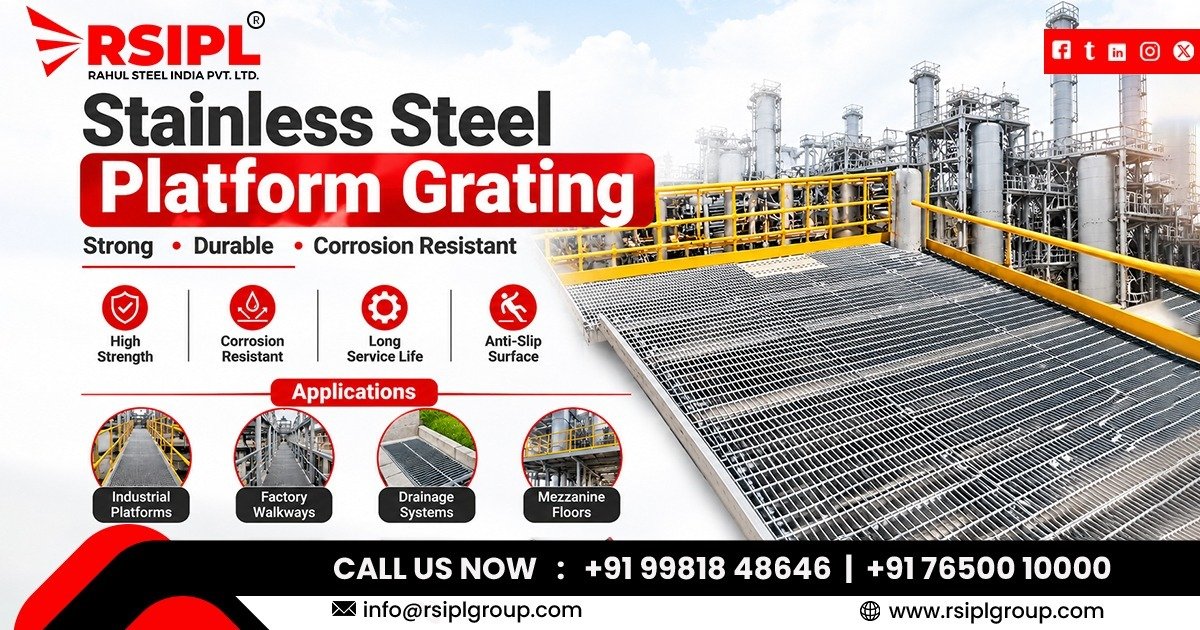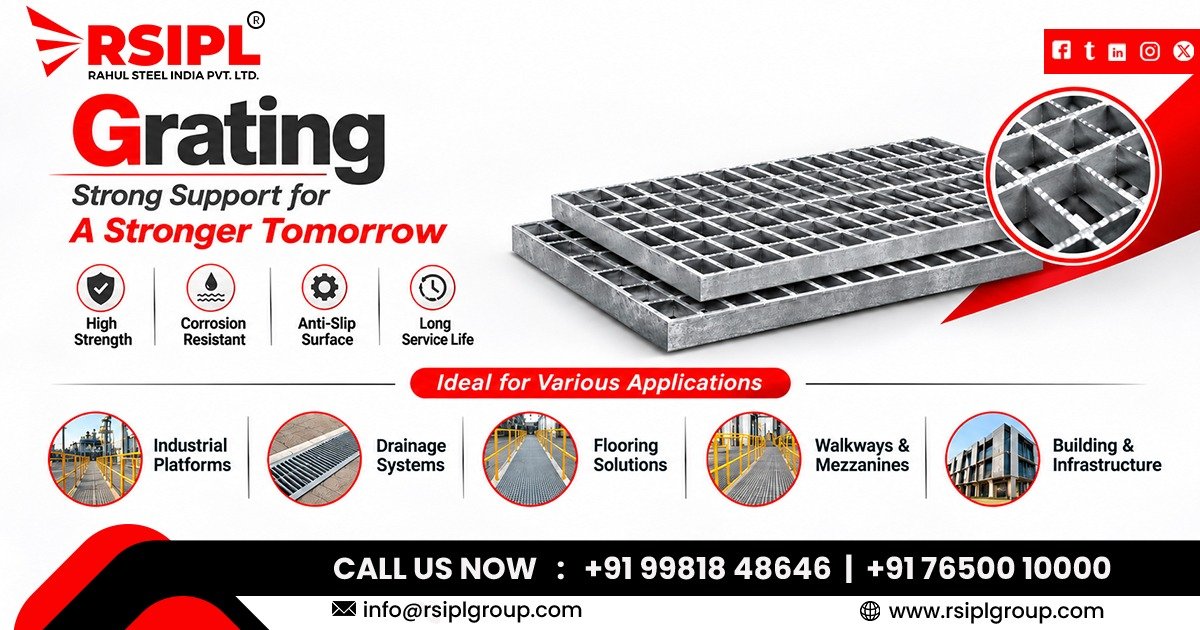
Industrial Floor Gratings for Heavy-Duty Drainage and Platform Applications help factories manage floor drainage, provide stable working surfaces, and create accessible maintenance platforms. Rahul Steel India Pvt. Ltd. offers manufacturing support from Ahmedabad, Gujarat, India, for industrial grating requirements.
Why Industrial Floors Need a Combination of Drainage and Load Support
Industrial flooring has to accommodate different operating conditions. Production areas may experience water accumulation, equipment movement, cleaning activities, and regular worker movement.
Conventional solid flooring may restrict liquid drainage, particularly around equipment foundations, utility sections, and processing areas.
Steel floor gratings provide an alternative through their open-grid construction.
They help industrial facilities address three important requirements:
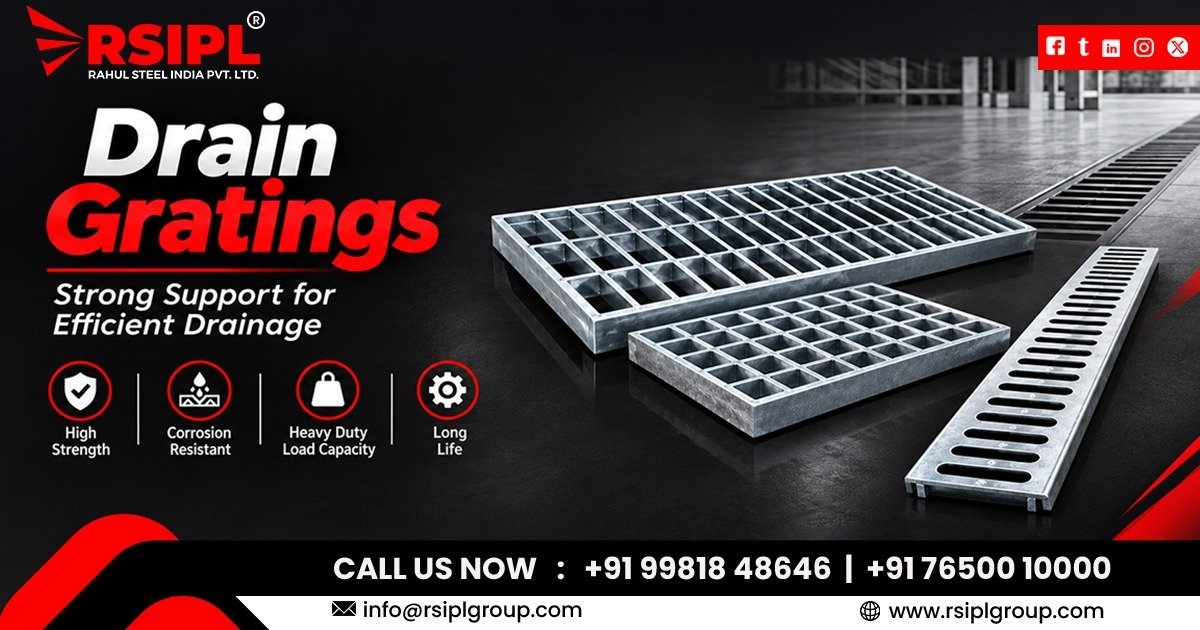
- Liquid drainage: Openings allow water and suitable process liquids to pass through into designated drainage channels.
- Working surface: Properly supported panels provide access for workers around machinery and industrial equipment.
- Maintenance accessibility: Removable or appropriately installed panels can provide access to underlying trenches and utility lines.
The grating design must match the actual operating environment, including expected loads, drainage flow, and safety requirements.
Understanding Grating Designs for Different Industrial Requirements
Not every industrial floor requires the same grating construction. Material, fabrication method, surface design, and panel arrangement influence the final selection.
Rahul Steel India Pvt. Ltd. offers different grating categories for industrial and infrastructure applications.
Common configurations include:
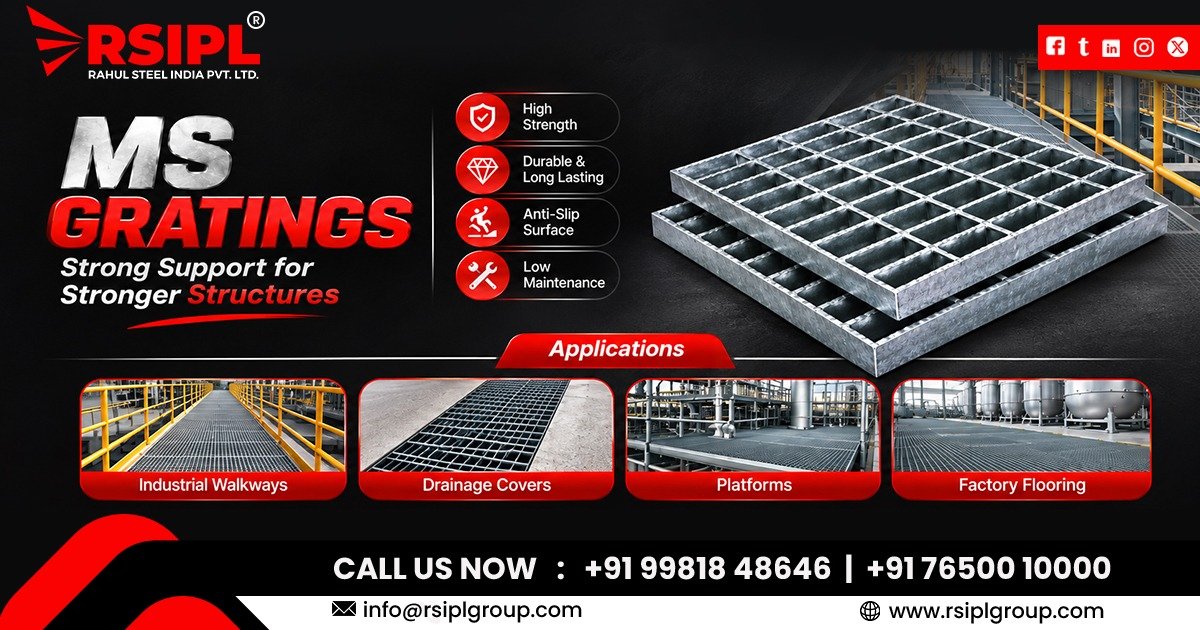
1. Mild Steel Grating: Suitable for industrial flooring, drainage covers, walkways, and platforms where structural strength and project cost are important considerations.
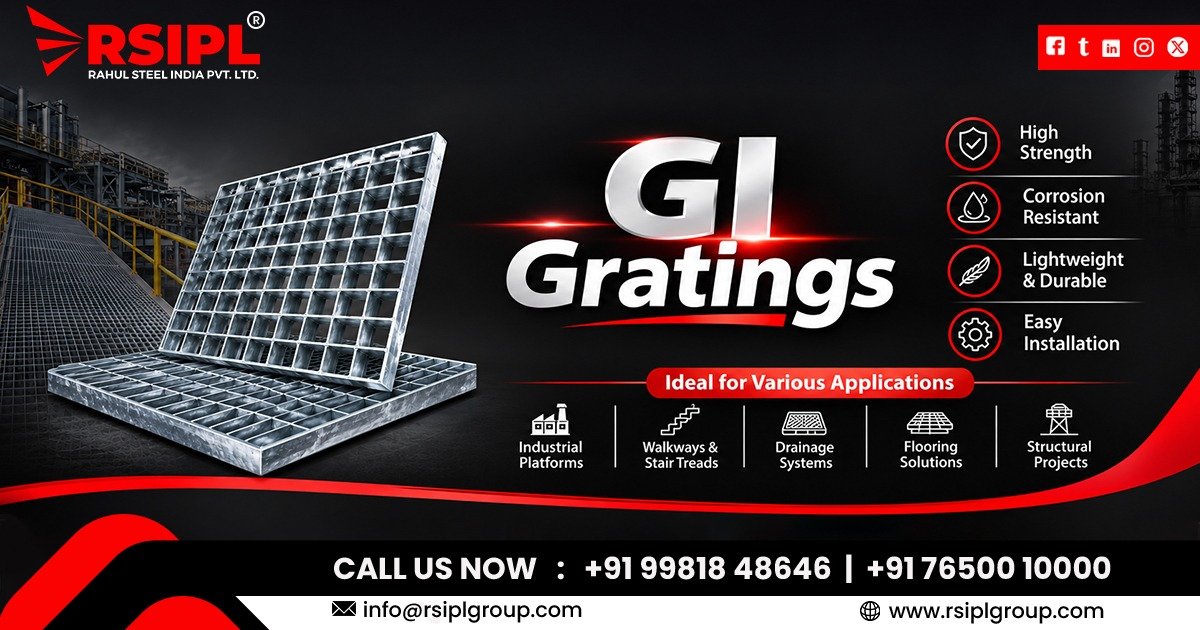
2. Galvanized Iron Grating: A practical option for outdoor and moisture-exposed areas where zinc coating provides corrosion protection.
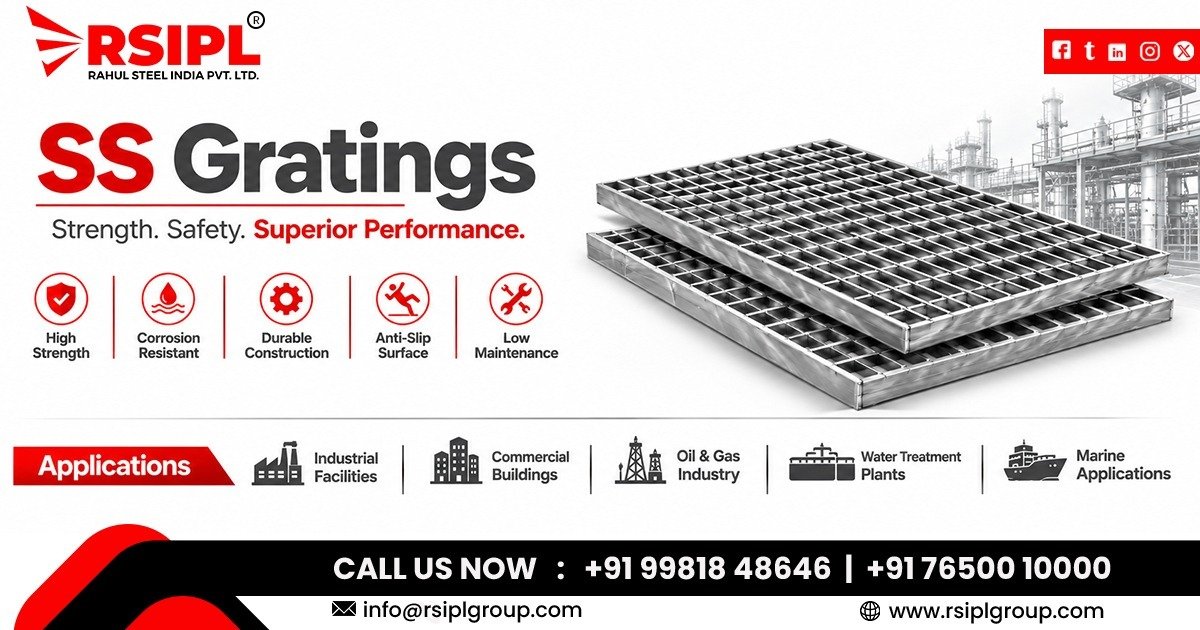
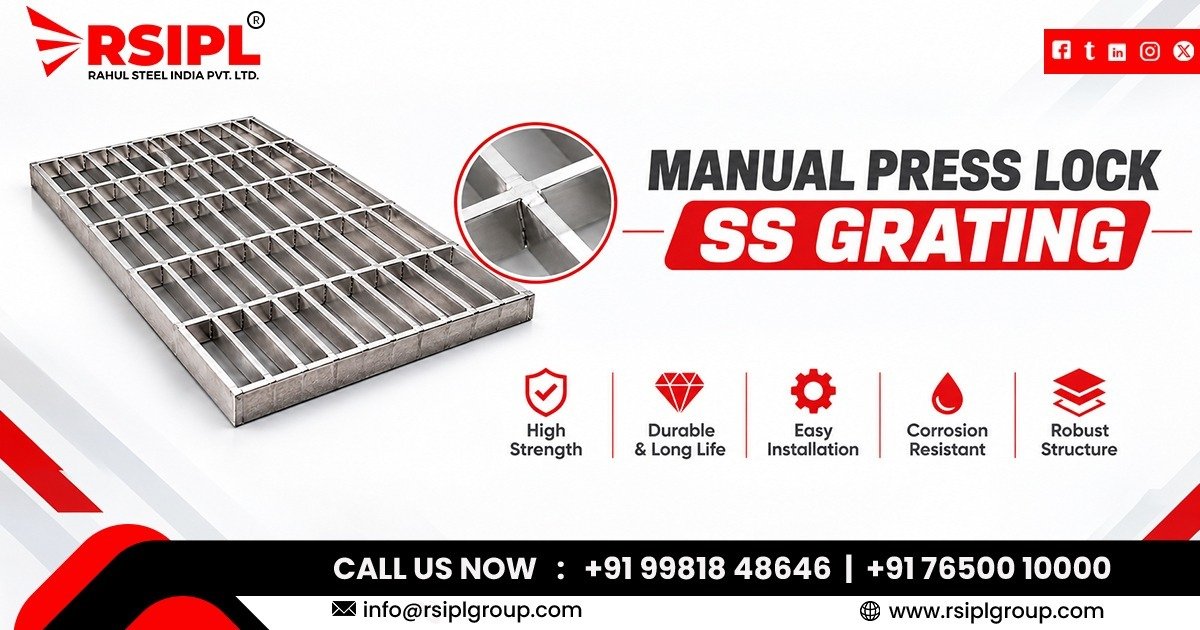
3. Stainless Steel Grating: Appropriate for environments where corrosion resistance and material compatibility are important.
4. Serrated Grating: Features a textured bearing surface to improve traction in wet or oily working conditions.
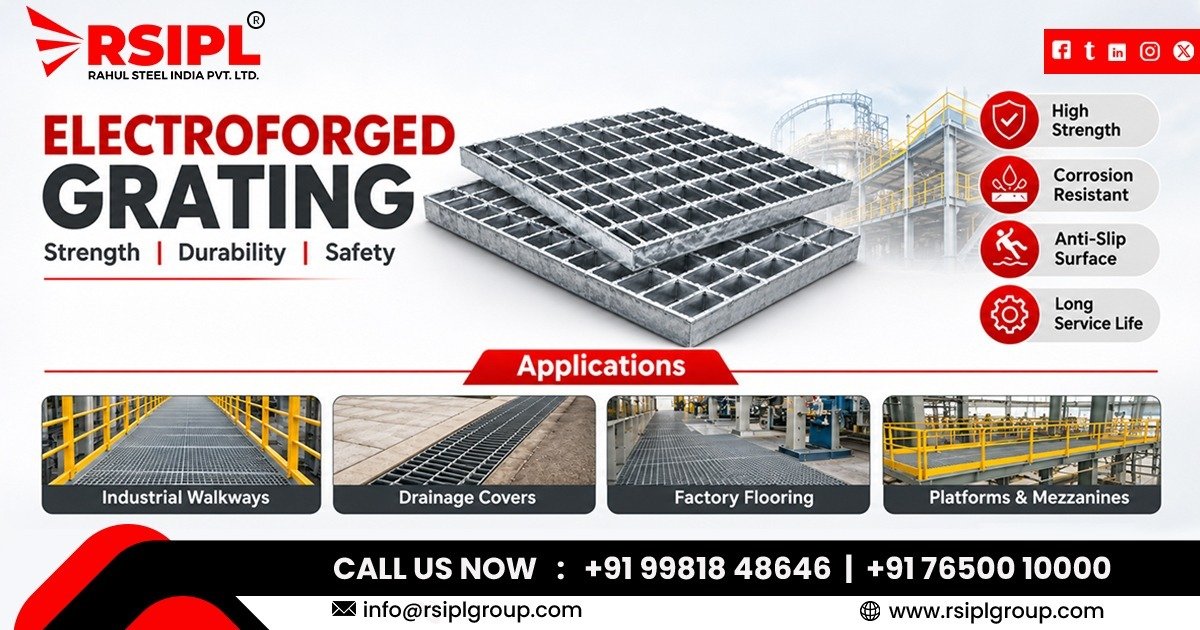
5. Electroforged Grating: Uses fused steel intersections to create a rigid grid structure for demanding industrial installations.
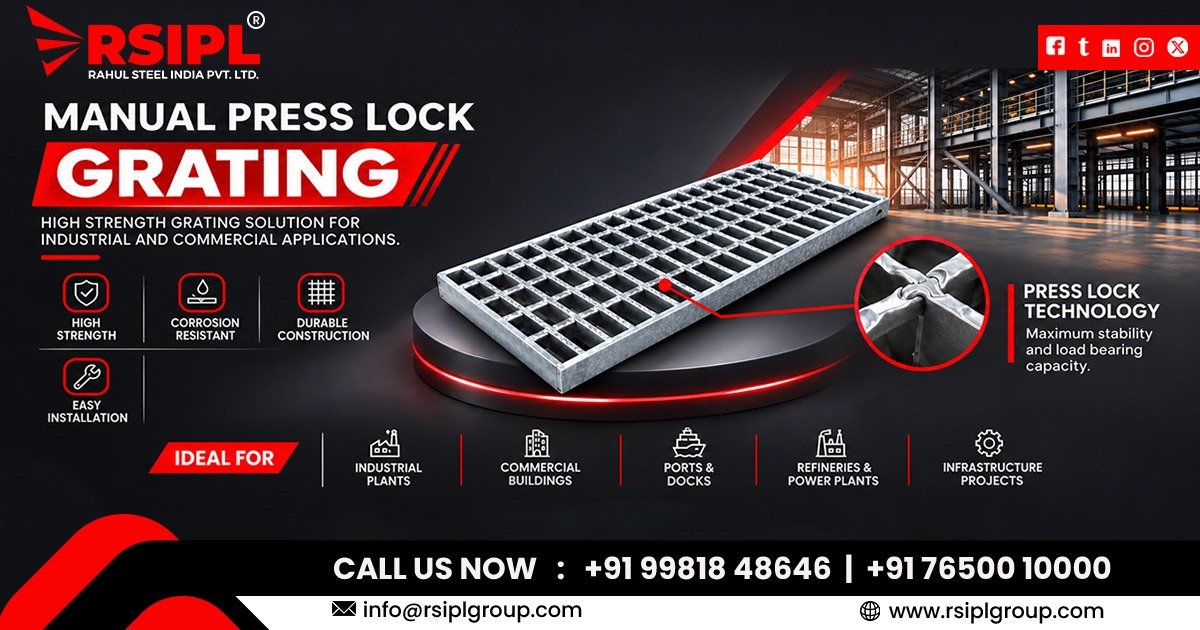
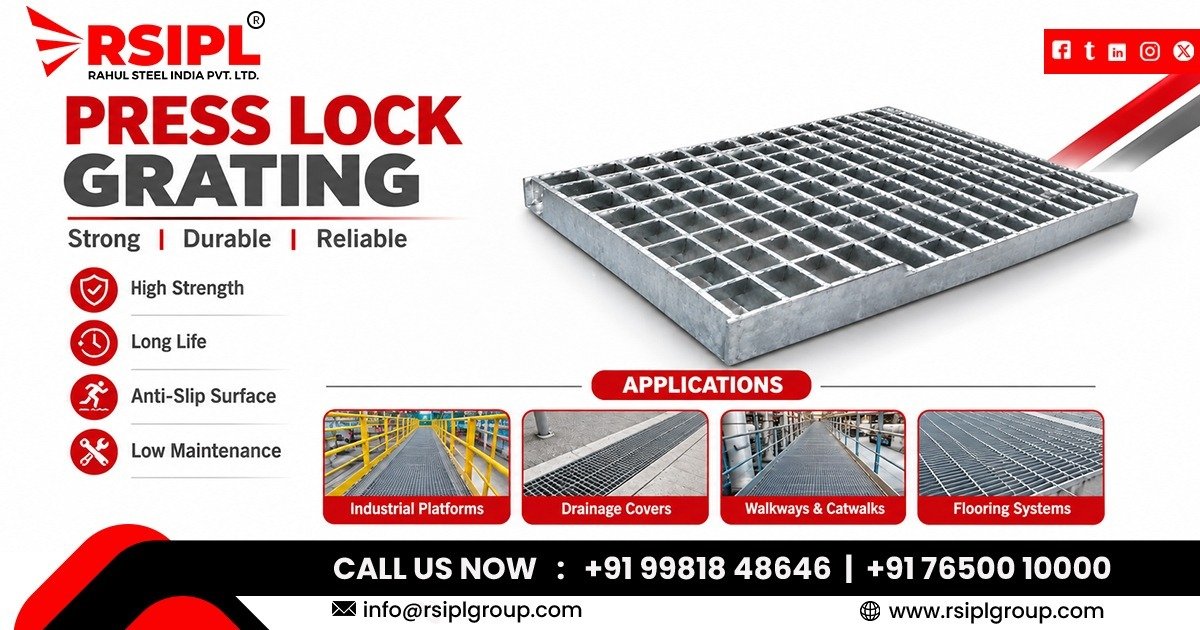
6. Manual Press Lock Grating: Uses mechanically locked bearing and cross bars to form a grating panel with a defined grid arrangement.
The selection should consider the installation environment rather than relying on the product name alone.
Load Distribution: What Engineers Should Calculate Before Ordering
A grating panel must transfer the applied load safely to its supporting structure. Selecting a panel only by its overall dimensions can create problems during installation and operation.
Engineers and procurement teams should evaluate the following points:
- Design load: Identify whether the area will carry pedestrians, maintenance equipment, stored materials, or wheeled loads.
- Bearing bar dimensions: Bar depth and thickness influence the panel’s load-bearing behaviour.
- Bar spacing: The spacing affects load distribution, surface openings, and the suitability of the panel for the intended use.
- Support span: Measure the clear distance between supporting members because the same panel may behave differently across different spans.
- Deflection limits: Establish acceptable panel movement under the specified design load.
- Panel fixing: Confirm how the grating will be secured against movement or accidental displacement.
For heavy-duty installations, request load tables or engineering calculations based on the actual panel configuration, support spacing, and loading conditions.
How Open-Grid Flooring Improves Drainage Management
Drainage performance depends on more than the size of the grating openings. The complete drainage arrangement must work together.
A typical industrial drainage arrangement involves:
- Surface collection: Floor slopes guide water towards a designated trench or drainage channel.
- Grating placement: Grating panels cover the channel while maintaining an open passage for liquid flow.
- Liquid movement: Water passes through the grid into the drainage system.
- Collection and discharge: The channel directs collected liquid towards the appropriate collection or treatment point.
- Cleaning access: The arrangement should allow inspection and cleaning of the drainage channel.
Important planning considerations:
- Avoid positioning drainage channels where they obstruct regular material movement.
- Consider the type of liquid and possible chemical exposure.
- Provide suitable access for removing accumulated sludge or debris.
- Check that grating openings are appropriate for the expected debris size.
- Ensure the drainage channel has sufficient capacity for the anticipated flow.
A properly coordinated floor and drainage layout helps reduce standing water and makes routine cleaning more manageable.
Installation Checks for Industrial Platforms and Drain Covers
Incorrect installation can affect panel stability even when the selected grating is suitable for the design load.
Before installation, the project team should verify:
- Supporting beams and frames are aligned and properly secured.
- Bearing bars are positioned according to the specified support arrangement.
- Panel dimensions match the available opening.
- Adjacent panels have appropriate alignment and support.
- Grating clips or other specified fixing arrangements prevent unwanted movement.
- Drain covers remain accessible for inspection and cleaning.
- Platform edges and openings have appropriate fall-protection arrangements.
During installation and commissioning:
- Check the supporting structure before placing panels.
- Confirm panel orientation and seating.
- Complete the specified fixing arrangement.
- Inspect joints, edges, and transitions.
- Verify that drainage channels remain unobstructed.
- Conduct the required inspection before allowing normal access.
Installation should follow the approved project drawings and applicable site safety procedures.
Common Grating Problems and Practical Inspection Methods
Regular inspection helps identify problems before they affect platform access or drainage performance.
| Common Issue | Possible Cause | Practical Check |
| Panel movement | Loose or inadequate fixing | Inspect clips and securing points |
| Water accumulation | Blocked drainage channel | Check channel cleanliness and floor slope |
| Surface corrosion | Damaged coating or unsuitable material | Inspect exposed and damaged areas |
| Excessive panel deflection | Incorrect load or span selection | Review design calculations |
| Unstable panel edges | Improper supporting arrangement | Inspect bearing support and seating |
| Slippery walking surface | Oil, residue, or unsuitable surface profile | Review cleaning and surface requirements |
Preventive maintenance practices:
- Remove accumulated dirt and debris from the grid openings.
- Inspect welds, locked intersections, and bearing bars.
- Check for corrosion, deformation, and damaged protective coatings.
- Examine panel fasteners and supporting frames.
- Replace damaged sections after an appropriate engineering assessment.
- Follow the supplier’s recommendations for cleaning and maintenance.
Any damaged load-bearing panel should be assessed before the area is returned to normal use.
Procurement Checks That Prevent Grating Selection Errors
A purchasing decision should be based on an agreed technical requirement rather than panel price alone.
Use this checklist when preparing a purchase enquiry:
| Procurement Parameter | What to Confirm |
| Application | Drain cover, walkway, platform, or industrial flooring |
| Material | MS, GI, or SS as required |
| Load requirement | Actual design load and loading pattern |
| Panel dimensions | Length, width, and thickness |
| Bearing bars | Size, spacing, and orientation |
| Cross bars | Configuration and spacing |
| Surface profile | Plain or serrated |
| Finish | Painted, galvanized, or suitable specified finish |
| Installation | Support arrangement and fixing method |
| Documentation | Drawings, material details, and relevant test documents |
Common purchasing mistakes to avoid:
- Selecting a panel without confirming the support span.
- Ignoring chemical exposure and moisture conditions.
- Treating pedestrian-duty and equipment-duty requirements as identical.
- Overlooking fixing arrangements.
- Not checking the drainage channel dimensions.
- Failing to discuss replacement-panel requirements.
A clearly defined enquiry helps manufacturers understand the application and recommend an appropriate configuration.
Industrial Grating Project Support From Rahul Steel India Pvt. Ltd.
Rahul Steel India Pvt. Ltd. manufactures and supplies different grating solutions for industrial flooring, drainage covers, elevated platforms, and access walkways.
Its product range includes MS Grating, GI Grating, SS Grating, Platform Grating, Serrated Grating, Drain Grating, Electroforged Grating, and Manual Press Lock Grating.
The company provides manufacturing support from Ahmedabad, Gujarat, India, for industrial steel grating requirements.
For project enquiries, customers can discuss:
Services
1. Grating Requirement Assessment: Understanding application conditions, expected loads, drainage requirements, and installation arrangements.
2. Material and Configuration Guidance: Evaluating suitable grating materials, surface profiles, panel arrangements, and fabrication requirements.
3. Manufacturing and Fabrication Support: Discussing grating production requirements according to the agreed project specifications.
4. Installation and Project Assistance: Coordinating installation-related requirements and technical discussions for industrial applications.
Visit the official website, Rahul Steel India Pvt. Ltd., to explore its grating product range and submit an enquiry.
Location
Industrial Floor Gratings for Heavy-Duty Drainage and Platform Applications are relevant to manufacturing facilities, engineering plants, infrastructure developments, and industrial construction projects across Gujarat. Manufacturing support from Ahmedabad can serve requirements in Ahmedabad, Sanand, Changodar, Bavla, Gandhinagar, Kalol, Mehsana, Kadi, Vadodara, Halol, Savli, Anand, Nadiad, Surat, Bharuch, Ankleshwar, Dahej, Vapi, Valsad, Rajkot, Morbi, Jamnagar, Bhavnagar, Gandhidham and Mundra.
Frequently Asked Questions
Q: How do I determine the load capacity required for an industrial floor grating?
A: Consider the expected load, loading pattern, bearing bar dimensions, and distance between supports. Request engineering calculations or load tables for the proposed configuration before purchasing.
Q: Which grating material is suitable for wet industrial environments?
A: GI and SS gratings are common options, depending on moisture levels, chemical exposure, and hygiene requirements. The appropriate material should be selected after evaluating the operating environment.
Q: Can floor gratings be used for both drainage covers and working platforms?
A: Yes. Gratings are used in both applications, but the design must match the respective loading, support, opening, and safety requirements.
Q: What should be inspected during routine grating maintenance?
A: Inspect bearing bars, cross-bar connections, fixing points, surface corrosion, deformation, and drainage openings. Replace or assess damaged panels before continued use.
Conclusion
Reliable industrial flooring requires proper coordination between drainage arrangements, structural support, and worker access. Industrial Floor Gratings for Heavy-Duty Drainage and Platform Applications should be selected according to load conditions, material compatibility, and installation requirements. Rahul Steel India Pvt. Ltd. provides manufacturing support from Ahmedabad, Gujarat, for these industrial requirements.
Planning an industrial drainage cover, walkway, or heavy-duty platform? Contact Rahul Steel India Pvt. Ltd. to discuss your grating specifications, material requirements, and project needs.
Call Us: +91 99818 48646, +91 76500 10000
Email: sales@rsiplgroup.com, info@rsiplgroup.com