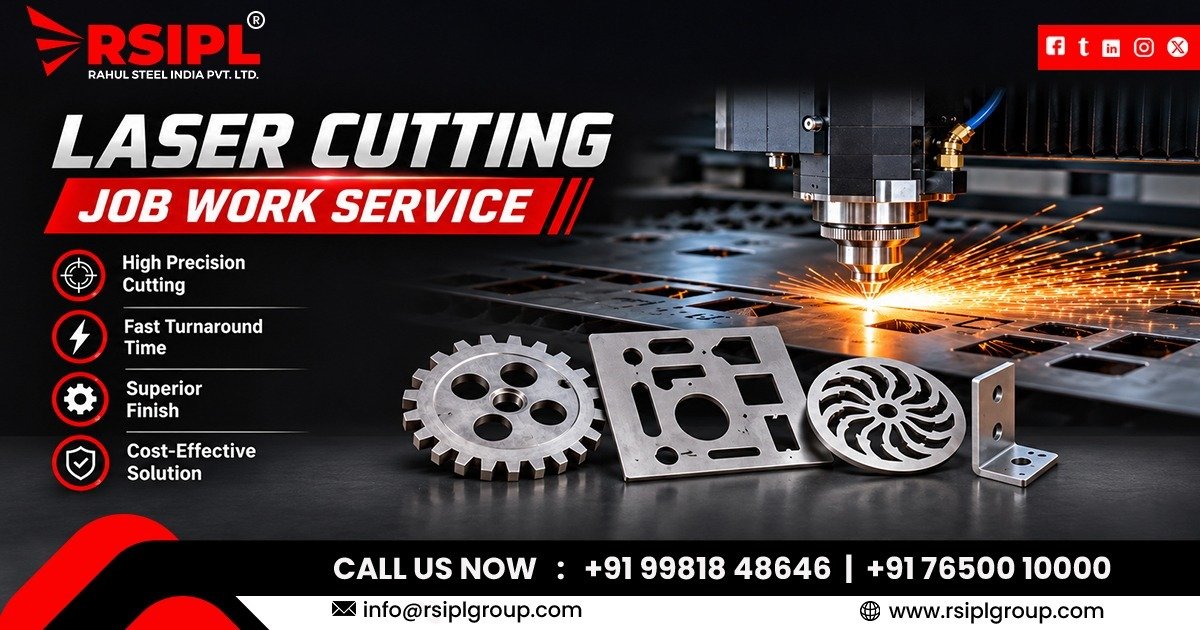
Industrial components often require accurate cutting, proper dimensions, and fabrication-ready finishing. Custom Sheet Metal Laser Cutting & Fabrication Job Work helps manufacturers meet these requirements. Rahul Steel India Pvt. Ltd. provides manufacturing support from Ahmedabad, Gujarat, India.
How Precision Sheet Processing Supports Fabrication Projects
Sheet metal fabrication involves converting flat metal sheets into components required for industrial equipment, machinery, structures, and customized assemblies.
Laser cutting is an important first stage because the accuracy of the cut component directly affects subsequent fabrication operations.
Businesses may require this service when:
- Their in-house cutting capacity is limited.
- Components have complex shapes or multiple cut-outs.
- Production drawings require accurate dimensions.
- Different component sizes are needed for one project.
- Repeat orders require consistent cutting layouts.
- They need cutting and additional fabrication processes through coordinated production.
Common requirements include mounting brackets, machine covers, electrical enclosures, support plates, base plates, panels, and customized metal profiles.
What Should Buyers Specify Before Sending a Cutting Job?
Choosing a fabrication partner requires more than sharing a drawing and requesting a quotation. Buyers should provide complete technical information to avoid unnecessary production corrections.
| Selection factor | What buyers should specify |
| Material grade | MS, SS, aluminium, brass, or copper |
| Sheet thickness | Actual material thickness in mm |
| Component dimensions | Length, width, holes, slots, and profiles |
| Drawing format | DXF, DWG, or another agreed CAD format |
| Order quantity | Prototype, small batch, or bulk production |
| Cutting requirements | Edge quality, accuracy, and dimensional tolerance |
| Secondary operations | Bending, welding, machining, or finishing |
| Delivery planning | Required quantity and project schedule |
Important purchasing consideration: Confirm that the material grade and thickness are suitable for the intended application and can be processed within the available machine capacity.
From CAD Drawing to Finished Metal Component: The Production Sequence
A properly planned cutting job moves through several stages. Each stage helps reduce drawing errors and avoid problems during assembly.
Step 1: Drawing and Requirement Review
The buyer shares the component drawing, dimensions, material details, thickness, and quantity.
The production team reviews the design to identify unclear dimensions, missing details, or possible manufacturing issues.
Step 2: CAD/CAM Programming and Nesting
The approved drawing is prepared for machine processing.
- Cutting paths are defined.
- Component positioning is planned.
- Sheet layouts are arranged.
- Material utilization is considered.
- Cutting instructions are prepared.
Step 3: Laser Cutting and Component Inspection
The selected metal sheet is positioned for cutting. The laser follows the programmed profile to produce the required component shape.
After cutting, important dimensions, holes, slots, and edge conditions should be checked against the drawing.
Step 4: Secondary Fabrication and Finishing
Depending on the project, cut components may proceed to additional operations such as:
- CNC press brake bending
- Welding and assembly
- CNC milling, drilling, or tapping
- Surface preparation and finishing
These operations help convert flat sheet components into parts ready for installation or further production.
Matching the Fabrication Process to Material and Design Requirements
Different metals behave differently during laser cutting and subsequent fabrication. Material selection should therefore be based on the component’s working environment and functional requirements.
| Material | Typical industrial requirements |
| Mild Steel (MS) | Machine frames, brackets, support plates, and general fabrication |
| Stainless Steel (SS) | Equipment panels, enclosures, and components requiring corrosion resistance |
| Aluminium | Lightweight panels, covers, and fabricated parts |
| Brass | Electrical, decorative, and specialized engineering components |
| Copper | Electrical and selected industrial components |
Before production, discuss the following points:
- Material grade: Confirm the exact grade rather than relying only on the material name.
- Thickness compatibility: Check the machine’s processing capacity.
- Edge condition: Specify the acceptable cutting finish.
- Dimensional tolerance: Define critical measurements, especially for mating components.
- Surface protection: Identify whether protective films or additional finishing are required.
Preventing Drawing and Fabrication Errors Before Production
A technically correct design can still create production difficulties if the drawing is incomplete or the fabrication sequence is not considered.
Buyers and production teams should pay attention to these common issues:
- Incorrect hole positioning: Verify hole centres and reference dimensions before approving the cutting file.
- Insufficient bending allowance: Consider bend radius, material thickness, and bend deductions when designing formed components.
- Unclear dimensions: Avoid relying only on drawing appearance or approximate measurements.
- Material mismatch: Ensure the supplied sheet matches the approved material specification.
- Poor component identification: Label different parts when an order contains multiple designs.
- Assembly difficulties: Check whether cut profiles, bends, and joining points fit the final assembly.
For repeat production, retaining an approved drawing revision and inspection record helps maintain consistency between orders.
When a Fabrication Project Needs More Than Flat Sheet Cutting
Some industrial requirements involve several connected manufacturing operations. In these situations, coordinating cutting with secondary processing can simplify production planning.
Rahul Steel India Pvt. Ltd. lists laser cutting services alongside fabrication-related capabilities, including CNC press brake bending, laser tube and pipe cutting, and precision CNC machining.
Depending on the approved project scope, customers can discuss requirements involving:
- Sheet cutting followed by bending for cabinets and enclosures.
- Tube and pipe profiling for structural assemblies.
- Machining operations for holes, slots, and component finishing.
- Welding and assembly for fabricated structures.
Planning tip: Share the final assembly drawing along with individual component drawings. This helps the production team understand how each part will fit into the complete product.
Quality Checks That Matter Before Accepting a Fabricated Order
Inspection should be based on the component drawing and its intended function rather than appearance alone.
Before accepting the finished job, buyers should verify:
- Material identification: Check the supplied material against the purchase specification.
- Dimensional accuracy: Measure critical lengths, widths, hole positions, and profiles.
- Cutting condition: Inspect edges for excessive burrs, dross, or unwanted irregularities.
- Bending accuracy: Check bend angles and overall component dimensions.
- Weld quality: Where applicable, examine joints, alignment, and visible defects.
- Quantity verification: Match the completed quantity with the purchase order.
- Documentation: Confirm drawing revisions, inspection requirements, and agreed delivery details.
For components used in equipment assemblies, dimensional inspection is particularly important because small variations can affect alignment and fitting.
Custom Sheet Metal Laser Cutting & Fabrication Job Work for Different Project Scales
Not every buyer has the same production requirement. A prototype component may need a different planning approach from a regular industrial order.
Rahul Steel India Pvt. Ltd. can be approached for discussions around different job-work requirements, including:
- Prototype development: Initial components prepared according to approved drawings.
- Small-batch production: Limited quantities for specific equipment or fabrication projects.
- Repeat manufacturing: Recurring component orders based on established drawings.
- Project-based fabrication: Multiple related parts requiring cutting and additional processing.
The feasibility of each requirement depends on material availability, design complexity, thickness, quantity, and agreed production capacity.
Services
- Sheet metal laser cutting and customized profile processing.
- CNC press brake bending and component forming.
- Laser tube and pipe cutting for industrial fabrication.
- CNC machining, welding, and finishing support for fabrication requirements.
Location
Manufacturing support from Ahmedabad, Gujarat, India, makes these services relevant to engineering companies, fabrication contractors, machinery manufacturers, infrastructure businesses, and industrial buyers across the region. Relevant industrial and commercial areas include Ahmedabad, Naroda, Odhav, Vatva, Kathwada, Changodar, Sanand, Bopal, Sarkhej, Aslali, Rakhial, Bapunagar, Nikol, Narol, Ramol, Hathijan, Isanpur, Maninagar, Amraiwadi, Chandkheda, Gota, Thaltej, Vastral, Dholka, and Bavla.
How Rahul Steel India Pvt. Ltd. Supports Industrial Fabrication Requirements
Rahul Steel India Pvt. Ltd. works in industrial fabrication, steel processing, and related engineering solutions. Its website, rsiplgroup.com, lists fabrication and laser cutting services within its product and service range.
For customers planning customized metal components, the company can be approached to discuss:
- Drawing-based component requirements and material selection.
- Cutting and fabrication process coordination.
- Additional bending, machining, and finishing requirements.
- Project specifications, production planning, and delivery coordination.
With manufacturing support from Ahmedabad, Gujarat, India, the company provides a point of contact for industrial buyers evaluating sheet metal processing and fabrication job work.
Frequently Asked Questions
Q1: What information is required to get a sheet metal laser cutting quotation?
A: Share the material grade, sheet thickness, component dimensions, CAD drawing, required quantity, and any secondary fabrication requirements to obtain a project-specific quotation.
Q2: Can laser cutting handle customized industrial component designs?
A: Yes. Suitable CAD drawings can be used to prepare customized profiles, mounting plates, brackets, panels, and other components, subject to machine capacity and design feasibility.
Q3: Why should bending requirements be considered before laser cutting?
A: Bending affects the final component dimensions. Bend allowance, material thickness, radius, and forming direction should be considered during drawing preparation.
Q4: What should I check when selecting a fabrication job-work company?
A: Evaluate its material processing capabilities, drawing understanding, dimensional inspection practices, secondary fabrication facilities, communication, and ability to meet your production schedule.
Conclusion
Accurate metal components require proper drawing preparation, material selection, cutting, and fabrication planning. Custom Sheet Metal Laser Cutting & Fabrication Job Work can support industrial projects in Ahmedabad and beyond. Rahul Steel India Pvt. Ltd. offers manufacturing support for customers planning customized metal processing requirements.
Have a sheet metal component drawing or fabrication project? Contact Rahul Steel India Pvt. Ltd. through rsiplgroup.com to discuss your material, dimensions, quantity, and technical requirements.
Call Us: +91 99818 48646, +91 76500 10000
Email: sales@rsiplgroup.com, info@rsiplgroup.com