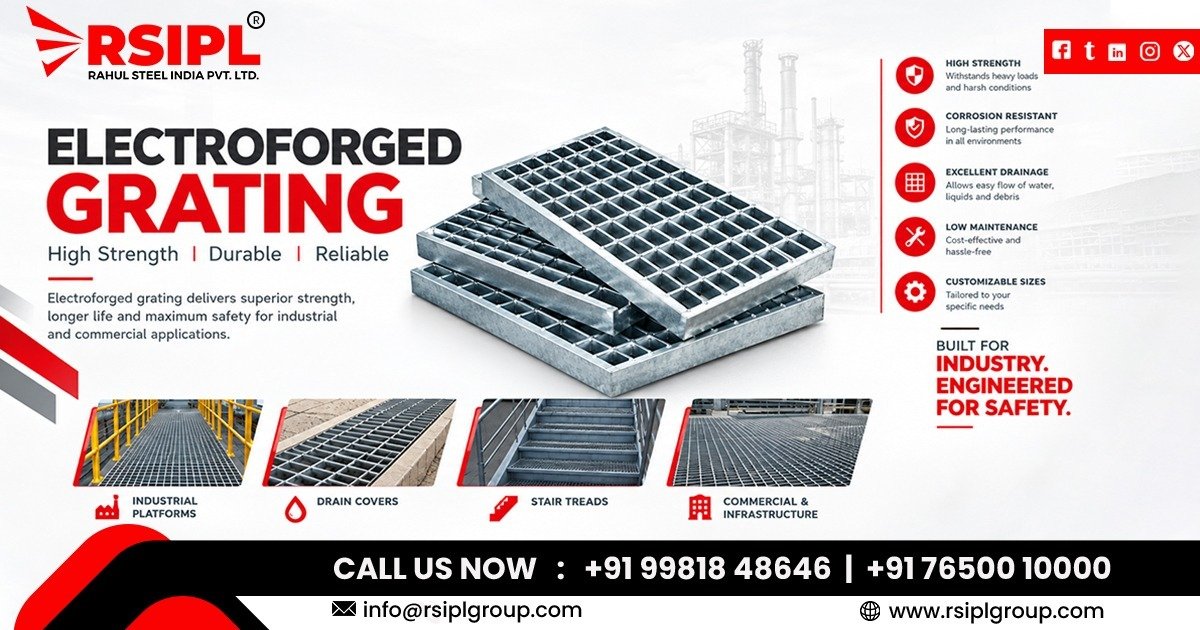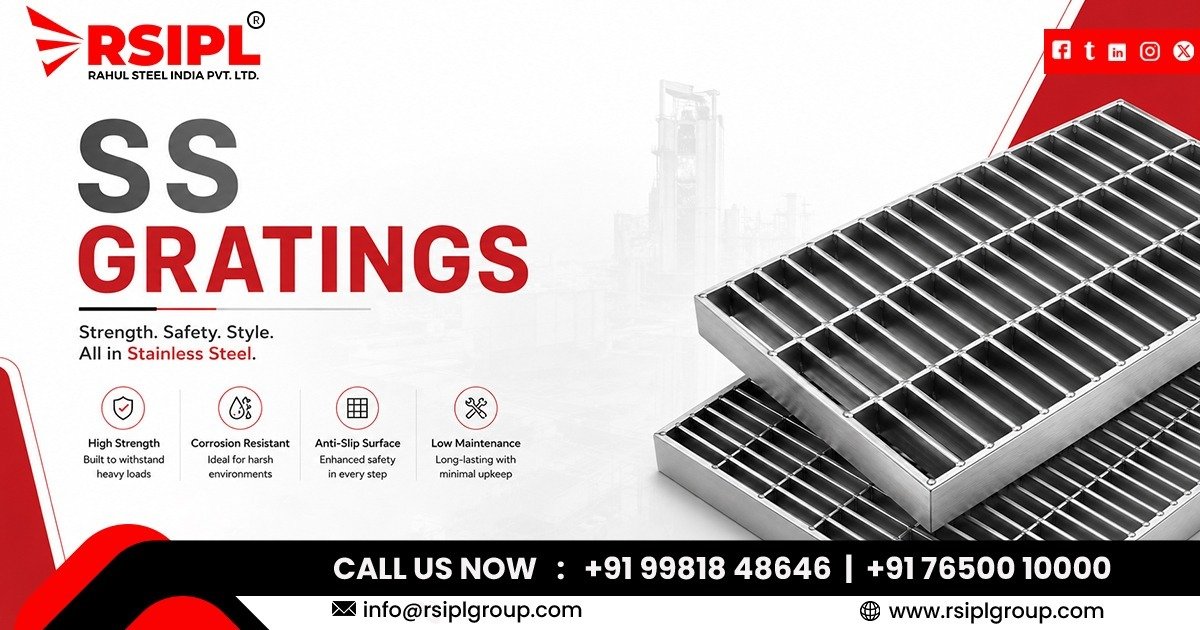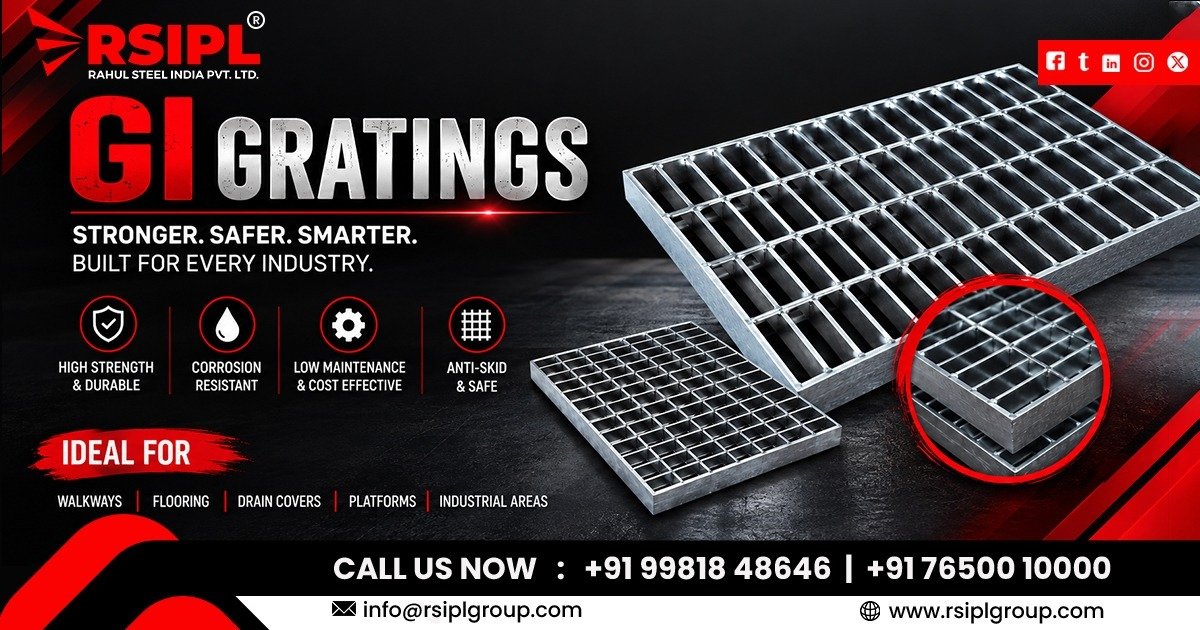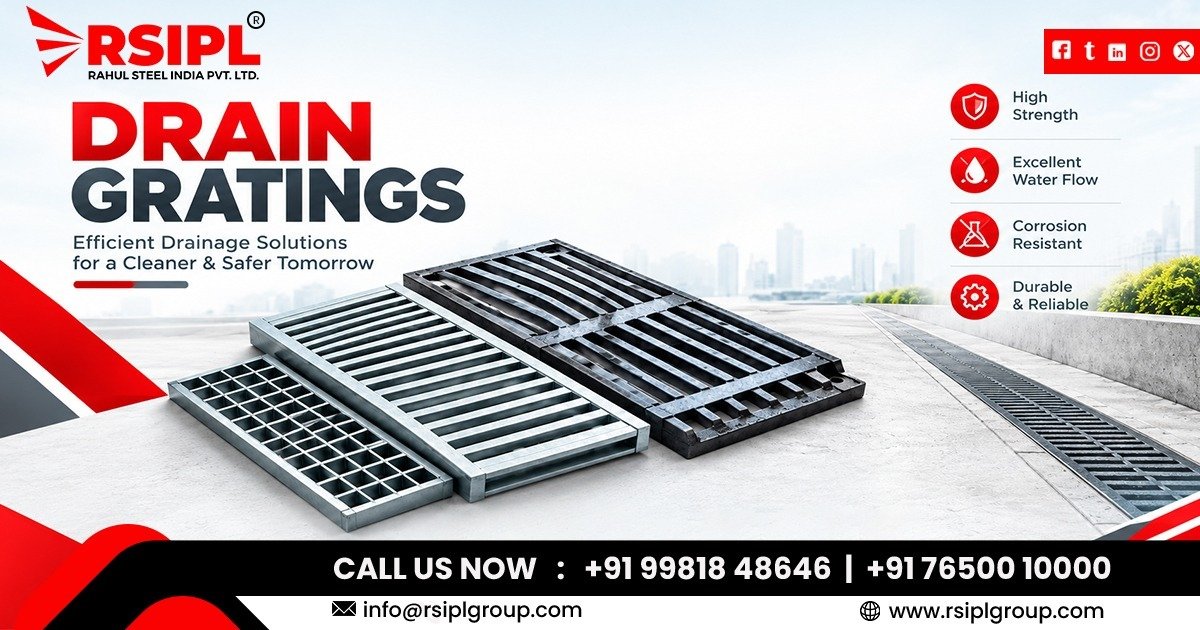
Drainage points in industrial and commercial areas need grating that allows water flow while supporting safe movement and easy cleaning. As a Drain Gratings Supplier In Uttarakhand, Rahul Steel India Pvt. Ltd. supports requirement-based selection with manufacturing support from Ahmedabad, Gujarat, India.
Start With the Drainage Point, Not Just the Grating
A drain grating covers an open drainage channel while allowing surface water to enter the drainage system. The correct selection depends on where the grating will be installed and what loads it will encounter.
Before ordering, identify:
- Indoor or outdoor installation
- Pedestrian or vehicle movement
- Drain opening dimensions
- Expected water flow
- Exposure to moisture, chemicals, or weather
- Removable or fixed installation requirements
- Cleaning and inspection access
For industrial projects, these details should be confirmed before finalizing dimensions or material.
How to Match the Grating With Site Conditions
Different locations place different demands on drainage covers. A pedestrian walkway does not have the same requirement as a loading area or vehicle-access road.
Consider the following:
| Site condition | Points to verify |
| Factory floor | Drain dimensions, cleaning access and regular movement |
| Commercial walkway | Safe surface and proper fit |
| Parking area | Expected vehicle loading |
| Processing area | Moisture, cleaning chemicals and hygiene requirements |
| Outdoor drainage | Weather exposure and water flow |
| Utility area | Access for inspection and maintenance |
A buyer should provide actual site conditions rather than selecting a grating only from a standard size list.
Dimensions That Need to Be Confirmed Before Ordering
Incorrect measurements can create installation gaps, movement, or difficulty during maintenance. The supplier should receive accurate site information before fabrication or dispatch.
Confirm:
- Clear drain opening
- Overall required length and width
- Channel or frame arrangement
- Grating thickness or load requirement
- Support arrangement
- Number of pieces required
- Removable sections, if required
- Finished floor level
For large projects, prepare a simple layout showing each drainage point and its dimensions. This helps reduce confusion when multiple grating sizes are required.
Selecting Material for the Installation Environment
Material selection should follow the surrounding operating conditions. Areas exposed to continuous moisture, cleaning chemicals, industrial residues, or outdoor conditions may require different material considerations.
Ask the supplier about:
- Resistance required for the operating environment
- Surface condition and finish
- Cleaning method
- Expected mechanical loading
- Corrosion exposure
- Compatibility with surrounding drainage construction
Installation Planning for a Proper Fit
Installation generally starts after the drain channel, supporting frame, and finished floor levels have been prepared.
A practical sequence is:
1 – Check the opening: Confirm the actual drain dimensions at the site.
2 – Prepare the support: Ensure the supporting edges or frame are suitable for the selected grating.
3 – Position the sections: Place each section according to the approved layout.
4 – Check alignment: Verify that the grating sits properly without unwanted movement or obstruction.
5 – Inspect drainage: Confirm that the cover does not interfere with water entry or routine cleaning.
Cleaning and Maintenance Should Be Planned Early
Drain gratings are exposed to dust, sludge, leaves, process residues, and other debris depending on the location. Blocked openings can reduce effective drainage and create cleaning problems.
Routine attention should include:
- Removing accumulated debris
- Checking drainage openings
- Inspecting visible damage or deformation
- Checking seating and support areas
- Cleaning deposits from the surface
- Reviewing fasteners or fixing arrangements where applicable
The cleaning frequency should depend on site conditions. Areas with heavy residue or frequent water discharge may require more regular inspection.
Common Problems and Practical Checks
| Common Issue | Possible Cause | Practical Check |
| Water drains slowly | Debris around openings or blocked drain | Clean the grating and inspect the drain below |
| Grating moves during use | Improper seating or support | Check the frame and contact points |
| Surface damage appears | Unsuitable loading or impact | Review actual site loading conditions |
| Cleaning is difficult | Poor access or unsuitable section arrangement | Check whether sections can be safely removed |
| Uneven installation | Incorrect measurements or support level | Recheck opening dimensions and supporting edges |
Buyer Checks Before Finalizing the Order
A procurement team can reduce avoidable issues by confirming these points in writing:
- Exact opening and overall dimensions
- Required quantity and section arrangement
- Site loading conditions
- Material requirement
- Surface or finish requirement
- Drainage layout
- Installation method
- Inspection and cleaning access
- Drawings or dimensional confirmation
- Delivery requirements
- Replacement or spare-section requirements
- Technical support after supply
The Drain Gratings Supplier In Uttarakhand should be able to understand the application before finalizing the product configuration. Clear technical communication is particularly useful when the project contains multiple drain sizes or different operating zones.
Services
- Requirement assessment and drain-grating selection support
- Dimensional and project requirement consultation
- Manufacturing and order coordination
- Technical and after-sales assistance
Location
Drainage infrastructure is relevant across Uttarakhand’s industrial, commercial, hospitality, infrastructure, and institutional projects. Requirements may arise in Dehradun, Haridwar, Roorkee, Rudrapur, Kashipur, Haldwani, Pantnagar, Sitarganj, Ramnagar, Rishikesh, Kotdwar, Vikasnagar, Doiwala, Laksar, Manglaur, Bhagwanpur, Selaqui, Kichha, Bazpur, Jaspur, Nainital, Pauri, Almora, and Rudraprayag.
Industrial Support From Rahul Steel India Pvt. Ltd.
Rahul Steel India Pvt. Ltd. can assist buyers in discussing drainage requirements, dimensions, project conditions, and product selection. The company provides manufacturing support from Ahmedabad, Gujarat, India, allowing project requirements to be coordinated with its fabrication capabilities.
For project enquiries and product information, buyers can review the company website at rsiplgroup.com and share their drainage layout, dimensions, quantity, and operating conditions for discussion.
Frequently Asked Questions
Q: How should I select drain grating size?
A: Start with the actual drain opening and supporting arrangement. Also consider required section length, width, loading conditions, and access requirements before confirming the final size.
Q: What information should I send to a supplier for quotation?
A: Provide drain dimensions, quantity, site application, expected loading, material requirement, installation conditions, and any drawing or layout available for the project.
Q: What maintenance is required after installation?
A: Regularly remove debris, inspect drainage openings, check seating and supports, and look for visible damage. The inspection frequency should reflect actual site conditions.
Conclusion
Selecting a suitable drain cover requires more than matching a standard dimension. Drain size, site loading, material conditions, cleaning access, and installation support all affect the purchase. Buyers seeking a Drain Gratings Supplier In Uttarakhand can discuss these requirements with Rahul Steel India Pvt. Ltd. and plan the order accordingly.
Need help reviewing your drain-grating requirement? Contact Rahul Steel India Pvt. Ltd. with your dimensions, application details, quantity, and project conditions for product selection and technical discussion.
Call Us: +91 99818 48646, +91 76500 10000
Email: sales@rsiplgroup.com, info@rsiplgroup.com